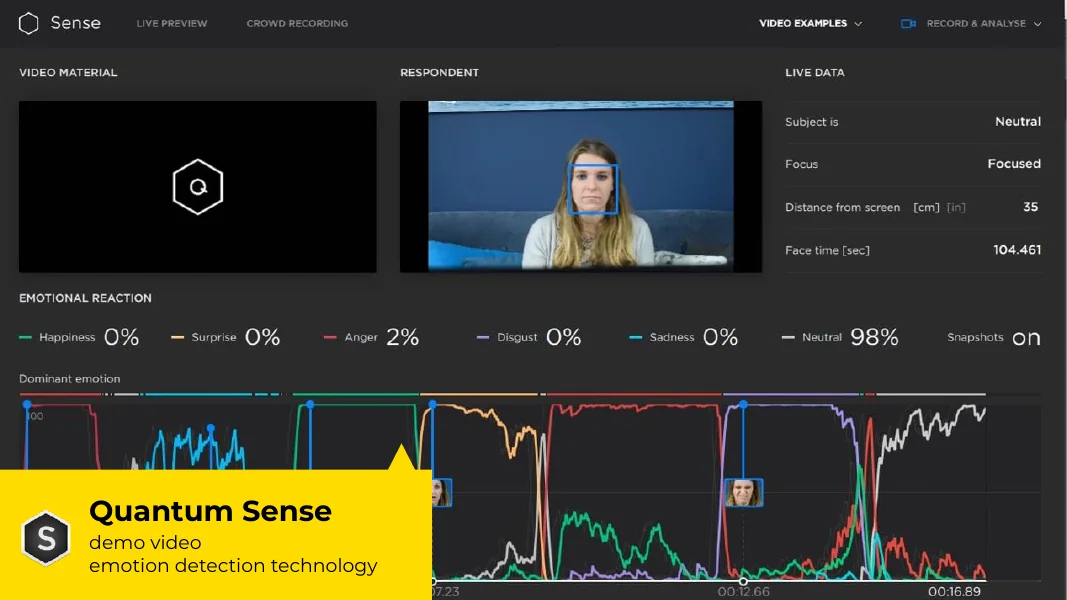
Quantum Sense
In 2013, I founded Quantum Lab, a company that taught computers to recognise human emotions. Our Quantum Sense engine read facial expressions from an ordinary camera and powered Ellen and Quantum CX.
- Client

- Year
- 2013–2021
- Time
- Quantum Lab since 2013 · engine since 2015
- Area
- AI rollouts
Reactions you can see on a face
A survey collects an opinion after the fact, once a person has had time to think it over. We wanted to know what happens in the moment: the second of an ad when a viewer smiles, or when a customer at the counter gets annoyed. We wanted a computer to read this from facial expressions, without sensors on the body. A laptop camera or a small camera in a shop was enough.
My role: from founding the company to selling a licence
I founded Quantum Lab in 2013 and ran it as CEO for the years that followed. We started with How Are You, a mobile mood journal. From 2015 we developed our own AI engine, first as Xpress Engine and later as Quantum Sense. I was responsible for the direction of the technology and products, the team, funding and sales.
Our funding included a PLN 3 million grant from the Polish National Centre for Research and Development’s Fast Track programme. In 2016 we sold the rights to Ellen and a Quantum Sense licence to a UK company. Someone paid for technology we had built from scratch, and for me that was the best proof of its value.
How the engine worked
First, the engine found a face in the frame, even when the person was not looking straight at the camera. Then it scaled and centred the face and corrected the lighting. Finally, it placed 68 landmarks around the eyebrows, eyes, nose and mouth. Machine learning models turned the movement of those points into five basic emotions and a neutral state.
Each version learned more. The engine recognised a person by their face, along with gender and age group. It measured distance and head tilt and checked whether someone was looking at a given spot. It tracked faces and bodies, assigned them IDs and re-identified people who came back into view. In the version for branches, a small Intel NUC computer ran four sensors at full performance.
We tested it against people
Cross-validating the models was not enough for us, so we built our own test platform. Trained judges labelled respondents’ emotions in recordings frame by frame, and we compared every new version of the engine with their ratings.
In our 2017 test, Quantum Sense recognised five emotions and the neutral state with 83.28% effectiveness. An average person watching the same recordings reached 46.33%. In the 2020 technology description, smile detection accuracy was around 99%.
One engine, several products
The first product on the engine was Ellen, a browser-based tool for testing reactions to ads, later developed as Quantum Insight. Within 18 months of launching the platform, 24 companies had used it. We studied 100,908 respondents, 450 ad campaigns and 600 videos, and our team analysed 804 hours of YouTube footage.
The same engine ran Quantum CX in banks and service points. There it counted the smiles of advisors and customers, and the platform turned them into rewards and support for charities. Our technology presentation also described further uses: fraud detection in video channels, gaming, robotics and security.
Where we were featured
We presented Quantum Lab’s technology and products at TEDx, infoShare, TechCrunch and Cyber 6.0. Forbes, TVP1, NowyMarketing and Marketer+ covered our work. We received recognition from Horizon 2020, GO_GLOBAL.PL and Innovation AD.
Quantum CX, built on this engine, later won silver at EFMA 2019 and first prize in the UPC Think Big competition.
The engine found a face in the frame, placed 68 landmarks on it and classified emotions. We started with SVMs and classic neural networks, then moved to convolutional networks. With OpenVINO, OpenCV and MKL-DNN, an Intel i3 processor could analyse 25 frames per second, even with several people in view.
Result
Two products on one engine, 100,908 research respondents and a licence sold to a UK company in 2016.
The technology is no longer available commercially, and we suspended the company’s operations in 2021. These are archive recordings from 2015–2016 and a frame from a 2020 presentation.